
Artificial Intelligence
2026 Cybersecurity Predictions: Identity Becomes the Interface
Monday, December 22, 2025

|
Austin Harris |

Dwayne McDaniel, Senior Developer Advocate at GitGuardian, offers his perspective on how the focus of AI-driven security is shifting from rapid innovation to governance, accountability, and human oversight as organizations head into 2026.
Dwayne McDaniel, Senior Developer Advocate at GitGuardian, offers his perspective on how the focus of AI-driven security is shifting from rapid innovation to governance, accountability, and human oversight as organizations head into 2026.
In 2025, nearly every security conversation circled back to AI. In 2026, the center of gravity will shift from raw innovation to governance. DevOps teams that rushed to ship AI capabilities are now on the hook for how those systems behave, what they can reach, and how quickly they can be contained when something goes wrong.
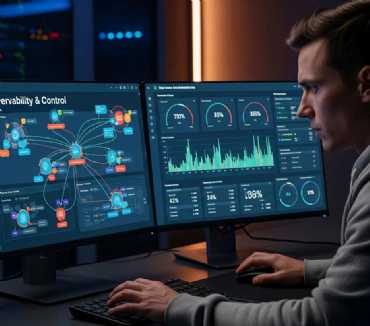
At the same time, observability, compliance, and risk are converging. Enterprises are designing for resilience rather than just visibility, with telemetry, audit, and access data landing in unified, identity-centric views. Through all of it, the human layer remains the differentiator. Mentoring, oversight, and ethical judgment will define who thrives in a world where machine autonomy meets operational accountability.
AI governance becomes the new DevSecOps
In 2025, DevOps quietly became the default owner of AI risk because they owned deployment. Teams were told to apply the same lifecycle discipline they use for continuous integration and delivery to large language model operations. For 2026, McDaniel expects that pattern to harden and expand.
AI governance will move directly into DevSecOps workflows. That includes prompt hygiene, adversarial simulation, and structured review of model behavior alongside traditional code and infrastructure checks. Policy as code will evolve from an infrastructure concept into a way to define how AI agents operate, who can invoke them, and how outputs are validated before execution.
Instead of static, role-based entitlements, McDaniel anticipates projects focused on AI access governance that continuously evaluate agent behavior against risk models. As AI systems gain reasoning and action capabilities, their access models must evolve from simple allow or deny to contextual authorization that accounts for intent as well as permission.
He also expects a wave of prompt provenance systems in 2026. Prompts will be treated less like casual user input and more like executable code. Every instruction an AI executes will need to be signed, auditable, and protected from tampering, with revision history and chain of custody handled like a mission critical codebase.
Non-human and workload identity go mainstream
McDaniel predicts that 2026 is the year non-human identity (NHI) governance becomes table stakes. AI agents now hold credentials, invoke application programming interfaces, and write code autonomously. Many organizations are realizing they have created a shadow workforce of digital employees without any of the lifecycle rigor they apply to humans. There is no onboarding plan, no offboarding plan, and often no clear owner.
He expects identity-centric governance frameworks to emerge that unify secrets management, entitlement discovery, and AI lifecycle tracking. The core question will shift from "What is the secret?" to "Which identity used it, when, and why?" Platforms that currently handle human identity and access management or secrets security will push features that tie every non-human identity to a specific owner and lifecycle, from creation through rotation to revocation.
Workload identity will move from a niche concern to a front-row topic. McDaniel frames the shift as moving from "Does this entity have the right key?" to "What is this entity's identity, do we trust it, and what behavior do we expect from it?" Standards and projects such as SPIFFE and SPIRE, along with IETF work like WIMSE and efforts such as SPICE, have matured to help enterprises authenticate workloads at scale, but complexity and unclear return on investment have kept them in the "nice to have" category for many teams.
Agentic AI changes that equation. Once workloads are treated as entities making decisions on behalf of the business, every agent, service, and job needs a clear, provable identity that can be federated across platforms. McDaniel expects federated workload identity management to enter mainstream DevSecOps conversations as teams move beyond long-lived API keys and static tokens. With interplatform standards hardening, he anticipates workload tokens spreading beyond cloud native and Kubernetes clusters into broader infrastructure.
The practical consequence is that the idea of a perimeter disappears once workloads have agency and can transact across the public internet. Legacy patterns that failed for human access cannot simply be repeated for machine identities that can reach customer emails, payment data, and personal information at machine speed.
Composite identities and identity-first detection reshape operations
As non-human identities mature, McDaniel expects many teams to confront composite or blended identities, where a human and an AI agent share a permission set and a shared audit trail. Questions like "Who actually deployed this infrastructure?" or "Who is liable if this change fails?" will move from theory to audit findings.
Compliance teams will scramble to define shared accountability models. McDaniel anticipates new audit requirements that demand traceability of intent, not just action. Logs will need to capture who initiated a command, who approved it, and whether an AI system altered it before execution. That requirement will drive tighter integration between change management, identity systems, and logging platforms.
On the detection side, he expects blue teams to pivot their primary telemetry from endpoints to identities, sessions, and authenticator changes. This will be especially true in the browser, where extensions, cookies, and session artifacts form a real blast radius. Most enterprises run numerous unvetted extensions with high-risk permissions. McDaniel predicts a move from passive awareness to enforced allowlists, automated extension review, and cookie theft detections mapped to frameworks like MITRE ATT&CK.
Browser events will become high value identity signals feeding identity threat detection and response pipelines. These pipelines will look for consent-grant abuse, session hijacking, and impossible travel patterns faster than endpoint-only tools can manage. Agentic AI will get formal guardrails and a "badge" in this world: model registries, prompt as code practices, better managed identities, least privilege scopes, and attestation so agents can fetch logs or open tickets without going rogue. Change control hooks, drift monitoring, and quarterly AI access reviews will sit alongside human access reviews.
McDaniel also expects risk storytelling to start replacing risk theater. Executives will ask for impact clarity in plain language. The best teams will tie detections to revenue impact, legal exposure, and reputational blast radius, not just vulnerability counts. Penetration testing outputs will evolve from spreadsheets into decision briefs that sequence remediation in a way that respects freeze windows and uptime constraints. Instant revocation of access will become a governed control reserved for pre-approved keys where the containment value outweighs breakage risk.
From zero trust to containment security
Zero trust made "assume breach" a default posture. McDaniel believes 2026 will push that idea further into what he calls containment security. Containment security assumes compromise and designs for graceful degradation rather than catastrophic failure.
With adversaries increasingly targeting interdependent AI systems and synthetic credentials, defenders will need to plan for localized failure without systemic collapse. McDaniel expects to see micro-segmentation at the AI agent level, with each model isolated to a tightly scoped access window. Continuous validation loops between human operators and automated agents will become normal, as will cross-domain kill switches capable of revoking machine access instantly across systems when behavior drifts.
Amid all that automation, he predicts a reckoning around the value of human judgment. From gaps in offboarding to mentoring voids in cybersecurity hiring, teams are learning that automation only scales as well as the humans guiding it. The smartest organizations will double down on human in the loop design, embedding ethics, empathy, and context review into AI operations. Technical depth will matter, but adaptability and collaboration across security, DevOps, and policy teams will matter more.
AI economics, small models, and post-quantum cryptography
McDaniel expects enthusiasm for agentic AI to meet hard constraints in 2026. He points to two big roadblocks: token costs and hallucinations. While many vendors highlight the virtues of large language models, day-to-day users often find that these systems create new categories of work and risk. The most durable use cases look narrower: code generation, predictive sorting, triage in high volume environments such as security operations centers and help desks, and summarization or translation.
Once teams accept those limits, he predicts 2026 will become the year of small language models. Token costs will no longer be treated as an afterthought. Early patterns of "use AI everywhere at any cost" will collide with budgets as executives start taking LLM bills as seriously as cloud infrastructure bills. McDaniel points to reports that most AI deployments still have no clear return on investment and expects that data to drive harder scrutiny. Small language models that run locally and sidestep many token costs will become attractive to the same leaders who pushed for broad AI adoption in 2025, offering a familiar "do more with less, faster" narrative.
On the cryptography front, he argues that 2026 will be the year teams realize that post-quantum encryption is not free. Many engineers do not think about the network cost of Transport Layer Security because current key sizes are measured in bytes and feel effectively free in most environments. That comfort is built on today's trapdoor functions and hardware limits, which underpin lightweight schemes such as RSA.
Quantum computing is expected to break RSA, and post-quantum schemes are already emerging that lean on far more complex math. The good news, in McDaniel's view, is that approaches such as lattice-based cryptography appear mathematically resilient to foreseeable quantum attacks. The downside is that both keys and signatures become much larger, sometimes by several orders of magnitude. For the first time, encryption decisions will show up visibly in network and compute bills.
He expects some organizations to head toward minimally acceptable cryptography to control costs, while others will absorb the expense and market themselves as more secure than peers, even if a practical "Q-Day" is still 15 to 30 years away.
APIs, agentic AI, and the next attack surface
API adoption is not slowing. McDaniel describes APIs as the main control plane for how modern businesses run. From a DevOps perspective, every software as a service application, microservice, partner integration, or AI workflow tends to appear as another API. That familiar model will continue to shape new systems and keep older ones alive.
Agentic AI complicates the picture. Giving an agent access to calendars, tickets, cloud resources, or payments effectively means exposing it to a portfolio of APIs. That creates more tokens to manage, more chains of calls that no human explicitly designed, and more ways for a compromised or misled agent to abuse legitimate access at machine speed.
Attackers already favor APIs because they offer direct, well structured access to data and actions. With the right token or an authorization flaw, malicious traffic can blend in with normal calls. Defenders often struggle to know which APIs even exist. Shadow endpoints, unretired versions, and subtle business logic create gaps that basic scanning misses.
McDaniel believes APIs can be secured, but only if organizations treat them as first class assets. That means accurate inventories, consistent authentication and authorization, strong key management, and runtime monitoring that understands behavior across services. AI will push both sides. Attackers will use it to discover APIs faster, generate probes, and map logic. Defenders will use it to spot abnormal call patterns and help engineers decide on the right incident response steps. APIs are here to stay, and securing them will be a shared responsibility across security and engineering.
2026: Integration and Getting Real
Looking across these trends, McDaniel sees 2026 as the year AI, identity, and risk stop living in separate swim lanes. They converge into a single discipline of machine identity governance. The defining question shifts from "Can we secure AI?" to "How do we integrate AI into our security culture?" The balance between autonomy and assurance will define defense in 2026.
For teams that want to get ahead of the curve, McDaniel suggests a few starting moves. Name an owner for non-human identity with a measurable risk reduction objective. Stand up browser aware identity detections that treat extensions and sessions as high value signals. Rewrite incident response into repeatable, drilled procedures that assume agents and humans will both be involved.
If identity is now the interface to everything security cares about, 2026 is the year to start treating it that way.

Become a subscriber of App Developer Magazine for just $5.99 a month and take advantage of all these perks.
MEMBERS GET ACCESS TO
- - Exclusive content from leaders in the industry
- - Q&A articles from industry leaders
- - Tips and tricks from the most successful developers weekly
- - Monthly issues, including all 90+ back-issues since 2012
- - Event discounts and early-bird signups
- - Gain insight from top achievers in the app store
- - Learn what tools to use, what SDK's to use, and more
Subscribe here